



Same Opening Weekend, Different Results
By Andrea Nunez-Gamboa
In a rare occurrence, two Latino-themed films—Clika and The Dreamer Cinderella—competed at the box office this past January 23. The films simultaneous release offers a revealing look at how marketing strategies that address similar markets operate at opposite ends of the industry spectrum, namely studio-backed campaigns with substantial resources versus the limited marketing budget of independent films.
It is well documented that U.S. Latinos are the most avid moviegoers in the U.S. This matters not only because the film industry is experiencing sustained declines in movie attendance—limiting the discovery of new films and talent—but also because Latino audiences represent untapped economic potential.
A 2023 McKinsey’s research study found that the US film industry might generate an additional $12 to $18 billion annually if Latino cultural representation in films increased,.
Latinos account for roughly 30% of the U.S. economy with a collective GDP that would rank as the fifth largest in the world, according to The Latino Donor Collaborative, a think tank that produces yearly studies on the filmgoing habits of U.S.Latinos The disconnect between economic power and the industry’s representation of Latinos raises a persistent question: Why does Latino visibility in U.S. films remain so limited?
It is a complicated answer that includes the lack of studio greenlighting for Latino projects, smaller budgets, and limited marketing support. As a result, many Latino filmmakers turn to the independent route, where little to no funding is allocated to marketing. By the numbers, the disparity is striking: The ratio between a studio film’s marketing budget and an independent film’s is approximately 87 to 1.


Sol Trujillo, co-founder of the Latino Donor Collaborative (LDC) and former Fortune 200 CEO, argues that Hollywood studios are leaving billions of dollars on the table by failing to produce and properly market content for U.S. Latinos. Based on the 2024 LDC U.S. Latinos in Media Report, Latinos purchase 24% to 29% of all box office tickets, yet remain one of the most underrepresented groups on screen.
Same Opening Week, Different Budgets
The simultaneous release of the two Latino themed independent films Clika and The Dreamer Cinderella, represented a strong moment for Latino representation in cinema this past January. Led by Mexican American directors, producers, and actors, both projects reflected contemporary cultural themes. However, their markedly different production and marketing resources set the stage for contrasting box office trajectories.

Clika, a music drama directed by Michael Greene and produced by Jimmy Humilde, follows Chito (Jay Dee), a small-town musician whose viral success propels him into the world of corridos tumbados, a subgenre of regional Mexican rap music. Distributed in 522 theaters, the film benefited from the backing of Columbia Pictures, a Sony subsidiary with a robust marketing infrastructure. Given Sony’s existing ties to Humilde’s Latin record label Rancho Humilde, the project aligned seamlessly with the company’s brand ecosystem.
The Dreamer Cinderella tells the story of Xochitl, a fruit vendor whose life changes when a filmmaker casts her as the subject of a daring bet, revealing her as a hidden star. Directed and produced independently Dr. Ruiz Productions with first time director Dr. Jose Luis Ruiz, this independent film was distriubted in only 16 theaters by Atlas Distribution. The difference in marketing visibility between these two films is stark, but as the performance data will show, scale is not the only strategy at producers’ disposal to drive attendance.
Measuring Momentum, Not Scale
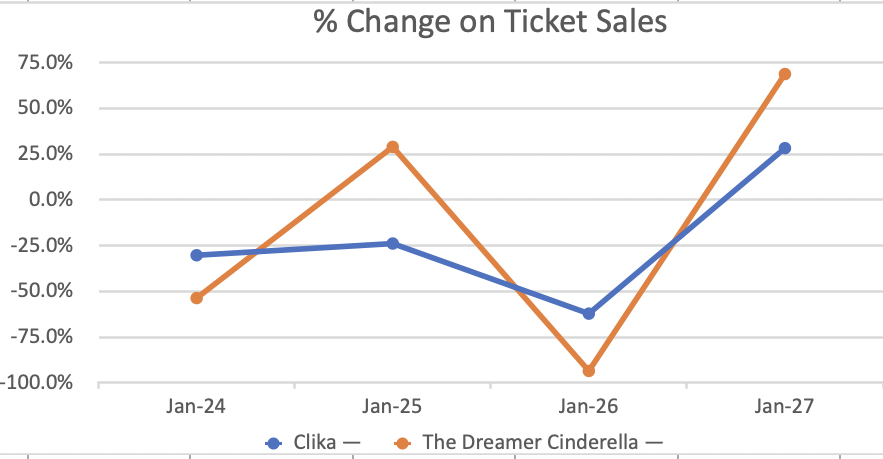
Trying to evaluate each film’s marketing effectiveness by comparing their total box office gross ticket sales would be unfair. Between January 23 and January 27, Clika earned $1,520,455 while The Dreamer Cinderella earned $8,880—a differential that reflects their vastly different scales of distribution. Instead, it is more equitable to compare the percentage changes in daily gross ticket sales respective to each film. This approach highlights momentum rather than reach, an especially useful lens for independent films whose full box office data is often underreported. While these limitations make a fully precise picture difficult, the figures still offer a meaningful basis for interpretation.

Takeaway: Clika
Clika’s performance data shows relatively moderate fluctuations, meaning the film experienced smaller declines following opening day and steadier rebounds throughout the opening week. This suggests consistent brand recognition and predictable audience reach. Even when attendance dips, the film’s structural visibility helps cushion the decline later in the week, allowing it to recover audience attendance by the following weekend.
This performance can be attributed to an ongoing baseline marketing presence supported by a studio-led campaign and a distributor such as Columbia Pictures/Sony. The strategy included a strong digital footprint, paid social media exposure, radio and podcast interviews, and billboard placements, which are elements that align with the comprehensive distribution and promotional approach typically associated with major studio releases.
Takeaway: The Dreamer Cinderella
The Dreamer Cinderella’s performance during opening week, by contrast, is characterized by sharp declines followed by a dramatic rebound, with its highest upward growth occurring on January 27 the last day of the theatrical run. This trajectory suggests a performance closely tied to marketing pushes, particularly those driven by community-based promotion, with targeted theaters, universities, film festivals, paid social media and community partners.
“…when the audience is targeted correctly, they respond.”
As an independent film, the key insight here is clear: When marketing aligns with audience outreach, the response is powerful. The spike in performance shows that when the audience is targeted correctly, they respond. Independent films can perform well, as audience interest often exists, but tailored marketing is required to make a meaningful difference during opening week.

In the case of The Dreamer Cinderella, there was an intentional effort to invest independent dollars into marketing, almost as a case study to test the idea that even modest marketing spending can influence performance and drive attendance.
Dr. Ruiz Productions joined forces with Entertainment Media Specialist to launch a groundbreaking case study of with The Dreamer Cinderella, and Latino independent film marketing. Modeled after major studio marketing strategies—but without the luxury of nine-figure budgets. The Independent Latino Film Marketing Campaign (ILFMC) study harnessed the power of grassroots community outreach, mobilizing Latino organizations nationwide and reaching out to independent thaters to screen the film through a film distributor and community engagement. Together all helped build a smart, targeted, community-driven release strategy.
FINAL THOUGHTS
“Ultimately, this analysis suggests that budget size matters less than how resources are allocated. As Latino audiences continue to grow and drive box office revenue, films made for these communities must be paired with marketing strategies that recognize their value and meet them where they are.”
The opening-week data makes one point clear, namely that marketing determines whether Latino audiences show up, not whether they exist. Clika’s steadier performance reflects sustained visibility, whereas The Dreamer Cinderella’s volatility reveals untapped demand that can be activated when outreach is strategic.
For Latino films, especially independent films, success is not a question of scale but marketing precision. When marketing investment is culturally informed and strategically deployed, independent projects can compete with large-scale commercial releases. In a market as powerful as the Latino audience, marketing is not optional. It is the difference between invisibility and impact, something that Latino movies should consider to gain a foothold in the film industry.
Ultimately, this analysis suggests that budget size matters less than how resources are allocated. As Latino audiences continue to grow and drive box office revenue, films made for these communities must be paired with marketing strategies that recognize their value and meet them where they are.