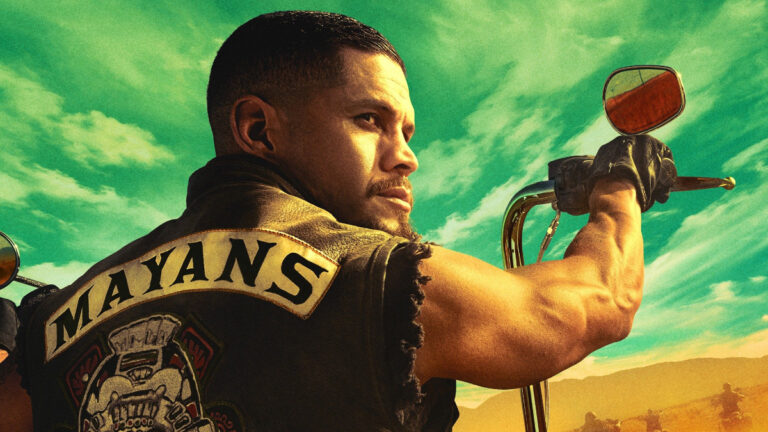
The biker drama Mayans M.C. will keep on riding on television. FX has ordered the fourth season of the series starring JD Pardo (East Los High) and Edward James Olmos (Battlestar Galactica).

Mayans M.C. is one of few dramas currently on American TV featuring a mainly Latino cast that includes Clayton Cardenas, Michael Irby, Carla Baratta, Raoul Max Trujillo, Richard Cabral and Danny Pino. Emilio Rivera, Sarah Bolger and Sulem Calderon also star in the series.

Clayton Cardenas, Kurt Sutter, Edward James Olmos & JD Pardo (Courtesy: FX)

A spin-off of the Golden Globe-winning Sons of Anarchy, the Latino series was created and is executive produced by Elgin James and Kurt Sutter. It follows Ezekiel “EZ” Reyes (Pardo), a newly patched member of the Mayans M.C. charter on the California/Mexico border. Once the golden boy with the American Dream in his grasp, EZ and his brother Angel (Cardenas) are closer than ever after uncovering the truth behind their mother’s murder while their father Felipe (Olmos) struggles to reconcile the choices he and his sons have made.

The renewal announcement is good news for the show, arriving just days before the end of its third season. Produced by 20th Television and FX Productions, the current season wraps up May 11.

“Elgin James, his creative collaborators, this incredible cast and crew delivered on another epic season of Mayans M.C.,” says Nick Grad, FX president of original programming. “Through three seasons, Mayans has told stories that resonate well beyond the border where the club thrives and survives, inviting fans inside their world and giving them a seat at the table.”

The show’s creator promises to dig deeper into the Mayans‘ characters in the season set to premiere in 2022. “I am deeply indebted to everyone at FX and 20th for allowing us to continue to tell the stories of the characters that Kurt (Sutter) and I created and whom our cast and crew took to new heights in season three,” says James, the executive producer. “In season four we look forward to diving deeper into each character’s truths, exploring the danger of the combustible world they inhabit, and for each writer, cast member and crew to stake out our place as storytellers.”

Among the show’s writers stands out Bryan Gracia (Chicago P.D.) and Debra Moore Muñoz (Westworld).

Mayans M.C. has received nominations for the Broadcast Film Critics Association, Critics Choice Award, California on Location Awards, Golden Trailer Awards and Imagen Foundation Awards.

(Courtesy: W!LLY)

Featured Photo: ‘Mayans M.C.’ (Credit: FX)

Walking With Herb premieres April 30, May 1, and May 3

By Bel Hernandez

As the theaters start to re-open, Walking With Herb, will lift spirits and touch hearts with Edward James Olmos and George Lopez in the lead roles as Joe Amable-Amo and Herb, respectively. You will see them in the kind of roles that will steal your hearts; two of the most well-known Latino talents in Hollywood in roles as you have never seen them play before.

Joe Amable-Amo (Olmos) is a bank executive and former amateur golfer, who after going through two deaths, the second one of his two-year-old granddaughter, has lost all hope and joy. Not even his wife, played by Kathleen Quinlan, can lift his spirits and dour outlook. Help come his way through God’s eccentric messenger, Herb (Lopez), via the golf course. Along the way, Herb explained that he’d been chosen to inspire the world and play in a world championship golf tournament.

With a bit of prodding from Herb, Joe goes along, helped by the fact that the cash prize will allow Joe to help his daughter save her child care business. Plus, the golf lessons from Herb, which help Joe win the tournament, take him out of his grim existence.

Lopez and Olmos’s chemistry as the teacher and the student, and how they play off each other, is reminiscent of the great buddy movies duos like Jerry Luis and Dean Martin but on a more spiritual level. “It is the best chemistry I’ve ever had [on screen] since Stand and Deliver,” Olmos told Latin Heat.

Academy Award-nominated screenwriter Mark Medoff wrote the role of Joe for Olmos specifically. Then Lopez came on board, and with the addition of Academy Award-nominated Kathleen Quinlan, the dynamic trio that carries the move was in place.

Olmos talks about working with Lopez and learning golf tips from him. “He actually did teach me how to play,” Olmos told us. “George is a brilliant golfer. He’s been playing golf since 1981. But I’ll tell you right now; he’s a better actor than he is a golfer after this movie,” Olmos declared

Walking With Herb is the right movie at the right time,” said Fathom Events CEO Ray Nutt. “As we emerge from a challenging year, we could all use a film that uplifts, entertains, and reminds us of what is possible.”

Produced by Optimism Entertainment and Rio Road Entertainment, Walking With Herb is directed by Ross Kagan Marks and written by Tonyâ winner and Academy Awardâ nominee Mark Medoff. Fathom Events will distribute.

The film is executive produced by Edward James Olmos, George Lopez, Joe S. Bullock, William Blaylock. Producers are Brian Espinosa, Ross Kagan Marks, and Mark Medoff.

Walking With Herb premieres April 30, May 1, and May 3for a three-night nationwide Fathom Events limited engagement. Find tickets at FathomEvents.com or WalkingWithHerbMovie.com.

Featured Photo: Fanthom

The uplifting, new film Walking with Herb takes audiences on an 18-hole rollercoaster ride as one man discovers how the impossible can become possible through faith, family and second chances . . . and with the help of God’s motorcycle-riding messenger!

Walking with Herb features Golden Globe and Emmy winner Edward James Olmos (Battlestar Galactica, Stand and Deliver) and comedy legend George Lopez (George Lopez Show). Academy Award nominee Kathleen Quinlan (Apollo 13) also stars in the film.

“It was one of the best experiences I’ve ever had working on a film,” said Olmos, who plays the lead character, and is an executive producer. “An amazing script and an excellent cast combine for a heart-warming, funny story about golf, belief and second chances.”

Joe Amable-Amo (Olmos) is a bank executive and former amateur golfer struggling with his faith after an unexpected tragedy. Faced with doubts about himself, his purpose and his belief in God, Joe is stunned when God tells him that he’s been chosen to inspire the world and play in a world championship golf tournament. Guided by God’s eccentric personal messenger, Herb (Lopez), Joe learns that the seemingly impossible is possible…through faith, family and second chances.

Walking with Herb is based on the book of the same name by Las Cruces, New Mexico, banker and golfer Joe S. Bullock. It was filmed in Las Cruces.

Walking with Herb premieres April 30, May 1, and May 3 for a three-night nationwide Fathom Events limited engagement. Find tickets at FathomEvents.com or WalkingWithHerbMovie.com.

“As we emerge from a challenging year, we could all use a film that uplifts, entertains and reminds us of what is possible,” said Fathom Events CEO Ray Nutt. “Walking with Herb is the right movie at the right time,”

Produced by Optimism Entertainment and Rio Road Entertainment, Walking with Herb is directed by Ross Kagan Marks and written by Tony winner and Academy Awards nominee Mark Medoff. It is distributed by Fathom Events. The film is executive produced by Olmos, Lopez, Bullock, William Blaylock. Producers are Brian Espinosa, Kagan Marks and Medoff.

— Latin Heat News Service

Featured Photo: Pinnacle Peak Pictures 

FX announced today that season 3 of Mayans M.C. is back for its long-awaited third season after over a year since season two ended. The audience can look forward to ten back-to-back new episodes that begin airing on FX on f March 15, 2021.

Season two left off with a newly patched Mayans M.C. member Ezekiel “EZ Reyes played by JD Pardo, his brother Angel (Clayton Cardenas) who disapproved of EZ joining. However, the brothers got closer, and they worked together to uncover the truth behind their mother’s murder, while their dad Felipe played by Edward James Olmos struggles to reconcile the choices he and his sons have made.

Also, there are the twist and turns of the stories we follow from the rest of the cast, including Richard Cabral, Danny Pino, and newcomer Emilia Tosta.

Also returning to the gritty motorcycle drama are Michael Irby, Raoul Max Trujillo, Emilio Rivera, Sarah Bolger, and Sulem Calderon.

https://youtu.be/h2OuK5XZUJ8

At the end of season two, we had U.S. Assistant District Attorney Lincoln Potter (Ray McKinnon), who threatened to deport Felipe, prompting EZ and Angel to step in; rebel leader Adelita (Carla Baratta gave birth to Angel’s son while federal custody. Meanwhile, Miguel Galindo (Pino) was left reeling after his mother’s apparent suicide, while others quietly suspect foul play. Additionally, the Mayans seek vengeance on their rivals, the Tijuana M.C. Vatos Malditos, after a surprise attack on their club. When the smoke clears, they discover the body of a Sons of Anarchy Motorcycle Club Redwood Original.

Mayans M.C. was co-created by Kurt Sutter and Elgin James and is executive produced by James, Michael Dinner and Sutter. The third season is produced by 20th Television and FX Productions.

— Latin Heat News Service

Featured Photo & Video: FX

Latin Heat News Services

Aztec dance troupe Huitzilopochtli. Photo by Cindy Marie Jenkins. Courtesy: Lucy Pollak Public Relations

The 24th Street Theatre’s annual Día e los Muertos block party is moving online. The virtual event allows people to celebrate the joyous tradition of Mexico’s most famous holiday from the comfort and safety of their homes on Monday, Nov. 2 at 6 p.m. (Pacific Time), 9 p.m. (Eastern Time) at www.24thStreet.org.

Hosted by actor Gabriel Romero, the virtual festival will feature special guests including master conguero, bandleader and vocalist Louie Cruz Beltran and his ensemble; Xochi Flores and Cesar Castro and their son Jarocho-Chicano Cambalache; Aztec dance troupe Huitzilopochtli; ballet folklórico Sol de Fuego; and Emmy and Golden Globe award-winning actor Edward James Olmos (Selena, Stand and Deliver, Battlestar Galactica)

Louie Beltran Cruz. Photo: Courtesy of artist

The event will also include: the presentation of Las Instrucciones, a short film about a man who builds an altar to connect, celebrate and remember; virtual workshops such as “How to Build a Small Day of the Dead Altar in Your Home” and “Face Painting for Day of the Dead;” and a “man on the street” check-in with celebrations in Mexico City. Also makin an appearance will be Los Angeles City Council members Gil Cedillo and Marqueece Harris-Dawson, who have partnered with 24th Street Theatre to make this event possible.

24th Street Theatre’s Día de los Muertos virtual block party is made possible in part by a grant from the City of Los Angeles Department of Cultural Affairs.

Featured photo: Host Gabriel Romero / Credit: Cooper Bates. Courtesy: Lucy Pollak Public Relations

By Cesar Arredondo

Actors Edward James Olmos, Julie Carmen and Pepe Serna will headline an online panel discussion about the lack of Latino representation in the entertainment industry this weekend in what is being called a “call to action” by event organizers.  

“The State of Latinos in Hollywood—The Systemic Brown Out of Latinos by the Entertainment Industry” will take place live via Facebook and YouTube at 5:30 p.m. (Pacific Standard Time) on Oct. 17.

The panel will also feature Thomas A. Saenz, president and general counsel of the Mexican American Legal Defense and Education Fund, and Claudia Puig, president of the LA Film Critics Association.    

The virtual event is presented by Latin Heat Media, owners of the entertainment trade website Latinheat.com, and palabra.  a digital news site founded by Alberto B. Mendoza, executive director for the National Association of Hispanic Journalists.

Bel Hernandez

A CONGRESSIONAL HEARING, NEWS MEDIA ABSENCE
The event comes just a month after a congressional hearing on the representation of people of color that received almost no attention from major media, including Hispanic outlets, and corporate Hollywood. In fact, the panel is in direct response of the dismissing, of what diversity advocates described as an “historic” hearing in Washington, D.C. in the middle of Hispanic Heritage Month by media outlets.

“The genesis of this live discussion came about due to the lack of coverage of the House Judiciary Committee hearing entitled ‘Diversity in America: The Representation of People of Color in the Media,’” says Bel Hernandez, Publisher and CEO of Latin Heat Media. “Hollywood’s disregard of the hearings and lack of media coverage, especially among Latino press, became the impetus for organizing such event.”

Hernandez adds, “I have to say that what I witnessed was quite historic. It had been almost 30 years since any type of judiciary hearing on diversity had been held. What I found incredibly disappointing was the lack of media coverage by film, television, and news outlets.”

Hernandez will moderate the Saturday virtual discussion. Latin Heat co-hosts the event along with palabra., an off-shoot of of the National Association of Hispanic Journalists.

PANEL TOPICS
The Oct. 17 panel will discuss issues affecting Latinos in entertainment including Hollywood’s disregard for Latino stories, Brown-facing, Latino diversity initiatives, access to the executive positions, systemic racism, representation in guilds, talent agencies and the trades.

Saturday’s goal is to “have a lively, honest and deep conversation on why the entertainment industry is so resistant in giving opportunities to Latinos to tell their stories or to have a meaningful participation in an industry that shapes the consciousness of America and the world,” says Hernandez. “We will address how race plays a key role in the exclusion of Latinos’ participation in this industry and we will offer concrete solutions.”

The challenges facing Latinos in Hollywood are indeed gargantuan.

DISMAL NUMBERS
A recent USC study of the 100 top grossing movies from 2007-2018 reports that only 3% of films featured leads or co-leads with Latino actors and only 4.5% of all speaking characters were Latino. Nationwide, Latinos make up more than 18 percent of the American population, according to the U.S. Census.

Those meager representation figures of Latinos in Hollywood might be even more shocking considering the geographic location of the so-called “world’s movie mecca.” “Despite all of the talk about diversity and inclusion in Hollywood and the popular press, these findings represent no change in depictions of the  largest ethnic group in America, who also comprise 39% of the population of the state of California, and 49% of Los Angeles’ population,” states the 2019 USC Inclusion Initiative Study “Latinos in Film: Erasure on Screen and Behind The Camera.”

And inclusivity may not the only problem for the largest American minority. “Erasure, not inclusion, is the norm for Latinos on screen,”  reads a key finding in that USC study. “Forty-seven percent of the 1,200 movies in the sample completely erased Latino speaking characters.”

ACTOR, FILMMAKER, ACTIVIST
Among the most vocal advocates for better Latino representation in Hollywood is Academy Award-nominated and Golden Globe-winning actor Edward James Olmos, one of the Oct. 17 panelists. With more than 40 films under his belt, including Stand and Deliver, two Blade Runner movies, and Selena and iconic performances in television series like Battlestar Galactica, Olmos is one the most successful Latino actors. With those filmmaking credentials earned over five decades of work, his opinion is sought-after.

I can tell you for the fact that those same actors are not testifying before you today because they are afraid. They are afraid of being blacklisted and punished for speaking truth to power.
I am not afraid. I have the truth on my side.” — Edward James Olmos

“Just because there are several successful Latino actors does not mean that Latinos are making it in Hollywood,” said Olmos in a statement submitted to the House Judiciary Committee’s hearing ‘Diversity in America” last month. “I can tell you for the fact that those same actors are not testifying before you today because they are afraid. They are afraid of being blacklisted and punished for speaking truth to power.” He adds, “I am not afraid. I have the truth on my side.”

AN URGENT APPEAL
For his part, veteran actor Pepe Serna has issued a “call to action to address and resolve the lack of inclusiveness and diversity in the entertainment industry.” At the same Congressional committee hearing, the Scarface and Car Wash actor said, “I challenge each and every one of you (to) become more familiar (with) and aware of the struggles and challenges that we as Latino Hollywood actors, producers, directors, technicians, and others supporting our trade face in our day-to-day activities.” Serna has been in the filmmaking business for about 50 years, working with with Oscar-winning producers, writers, directors, and actors in approximately 100 films and 300 television shows.

Panelist actor Julie Carmen has a career spanning over four decades. She rose to prominence after a high profile role in director John CassavetesGloria. Her credits include films like The Milagro Beanfield War, Mouth of Madness, and Fright Night Part two. She played Angelina Jolie’s mom in the Hallmark miniseries True Women and also starred in the TNT television film Gore Vidal’s Billy the Kid, opposite Val Kilmer.

Claudia Puig of the LA Film Critics Association brings an insightful journalistic perspective to media coverage within the industry, while Thomas A. Saenz of MALDEF looks at the issue of Latino representation in the movies through the legal and policy lens.

Says Saenz, “The routine practice of excluding Latinos in entertainment has created an ominous gap in comparison to population, and this pattern continues at our entire nation’s peril.” And he adds, “It’s not a stretch to conclude that this pattern contributed to the rise of an obscure presidential candidate who has built his political career around demonizing the Latino community.” 

To register for “The State of Latinos in Hollywood—The Systemic Brown Out of Latinos by the Entertainment Industry,” CLICK HERE.

For press inquiries CLICK HERE.

Hearing on Diversity in America: The Representation of People of Color in the Media

Rep. Joaquin Castro, (TX-20),Chair of the Hispanic Caucus along with Congressional Black Caucus Chair Rep. Karen Bass (CA-37), and Congressional Asian Pacific American Caucus Chair Rep. Judy Chu (CA-27) brought forth the House Judiciary Committee hearing on Diversity in America: The Representation of People of Color in the Media which was open to the public on youtube as well as the Judiciary Committee’s website.

Testifying virtually before the hearing were Actor/Director Erika Alexander, Actor/Director/Producer and activist Edward James Olmos, Actor/Producer Daniel Dae Kim, Recording Artist/Actor/Author Joy Villa, Jason Whitlock, Sports Journalist, Stacy L. Smith, on behalf of the Annenberg school of Communications and Journalism and Karyn A. Temple, Sr. VP and Global General Counsel fo the Motion Picture Association, Inc.

Veteran actor Pepe Serna submitted his Statement; and Alma Martinez’s statement is below in its entirety:

STATEMENT

I am Dr. Alma Martinez. I am an American film, television and stage actor and, as well,  a university professor and published author. I hold a PhD  in Drama from Stanford University, an MFA in Acting from the University of Southern California, a Dartmouth College Cesar Chavez Dissertation Fellow alum, a Fulbright Scholar and a member of the Academy of Motion Picture Arts and Sciences, Actors Branch (AMPAS). 

My induction into AMPAS reflects my extensive body of work in the films Zoot Suit, Under Fire, Barbarosa, Born in East LA, Cake, Transpecos, Crossing Over, Ms. Purple, Clemency and in TV programs such as Gentefied, Undone, Queen Sugar,  The Bridge, American Crime Story: People vs OJ,  Elena of Avalor, The Terror Infamy, Corridos Tales of Passion and Revolution, among others.  I have acted on Broadway, Off-Broadway, in regional theatres across the country and on Mexican and European stages. These combined projects have garnered; Sundance Film Festival Grand Jury Awards; Oscar, Golden Globe and Emmy awards/nominations; Tony Award and;  Los Angeles Drama Critics and New York Drama Desk awards. 

In my decades of working in the entertainment industry, I have shared the screen and stage with distinguished acting colleagues Gene Hackman, Edward James Olmos, Alfre Woodard, Lupe Ontiveros, Ed Harris, Jean Louis Trintignant, George Takei, Liev Schreiber, Diane Weist, Danny Trejo, Nick Nolte, Jennifer Aniston, Cheech Marin, Frances Conroy and worked with directors like Zack Snyder, America Ferrera,  Ryan Murphy, Ava DuVernay, Luis Valdez, Chinonye Chukwa, Roger Spottiswoode, Peter Medak, Jill Soloway, Fred Schepsi, Daniel Barnez, among others.

In my acting and professorial career, I continually work to move our Latino community and our country,  closer to becoming a true Democracy that affords the same opportunities to all. Prior to coming to Hollywood, I was a member of El Teatro Campesino, one of the most important political theatre companies of the 1960’s and 70’s. Founded by Luis Valdez as an organizing tool for the burgeoning Farmworkers Union led by Cesar Chavez and Dolores Huerta,  the company went on to win an Obie and for Luis Valdez, countless awards. For four months, we did a bus and truck tour across Europe playing in large Roman and small amphitheaters,  town squares, under tents and at international theatre festivals. In the U.S. our bus and truck tour crossed the Southwest for 6 months. We played at union. meetings, church halls, schools, school cafeterias, outdoor squares, and occasionally, a real theatre. Our play, La Gran Carpa de los Rasquachis, (The Grand  Tent of the Underdogs) with its message, demanding  human and labor rights for farm workers, rallied audiences and standing ovations in the U.S. and Europe. Up until that point, I had never experienced the power of theatre to change mind, hearts and lives. As a young actor in Hollywood, I joined NOSTROS the Latino Professional Actors organization founded by Ricardo Montalban to support and guide actors in Hollywood. As a member of SAG, I ran for office on a platform with other Latino actors, the first such effort in the union’s history. I have given presentations on  “The Evolution of  Latino Images in Film” at over 100 university, colleges, high schools and conferences across the  country. As a member of AMPAS I have reached out to other professionals of color to encourage and guide them through the nomination process which, up until ten years ago, had been a process closely guarded by existing members, the majority of whom where white men. To date, I have helped 10 entertainment professionals of color become members. 

As a director of theatre, I select plays that I feel speak to our place in time. Over the past three years, I’ve directed; Facing Our Truth: Plays on Trayvon Race and Privilege (multiple playwrights);  Luis Valdez’s Los Vendidos, Vietnam Campesino and Los Militants and I am currently directing Anna Deavere Smith’s play Twilight: Los Angeles, 1992. 

(L-R) Vicky Schecter, Marco Rodriguez, Enrique Castillo, Alma Martinez and Gordon Davidson, Artistic Director of the Mark Taper Forum

I received my first union card (Actors Equity Association) in 1978 when I performed in the play Zoot Suit written and directed by Luis Valdez. The play was the first entirely Chicano/Mexican American production,  including the playwright, cast and director, ever produced at Mark Taper Forum in Los Angeles. Zoot Suit  broke all existing box office records and then moved to the Aquarius Theatre for an extended 10 month run. For the first time in the history of Los Angeles professional mainstream theatre, Chicano and Latino audiences flocked to the Music Center, filled the 750 seat Mark Taper Forum and 1, 200 seat Aquarius Theatre,  to capacity. They sat enraptured by a play that depicted one of the darkest untold stories in Los Angeles history, the Zoot Suit Riots and the Sleepy Lagoon Murder Trial (circa 1945-47). What had for decades been a silenced and pained memory, became a celebration and vindication in the hands of master playwright Luis Valdez. In Valdez’s telling, Latinos aka Zoot Suiters were not the perpetrators of violence but rather victims of a judicial system that had historically failed to protect its most vulnerable citizens of color. 

The story of Henry Reyna and the 38th Street gang was story telling in its highest form. Each night, Chicano-Latino audiences were enraptured by Mr. Valdez’s mastery of the written word. The magnetic draw and almost breathless attention  as audiences saw for the first time, empowered, arrogant,  defiant, sensual,  and proud American of Mexican descent, the Pachuco, played by Mr. Olmos, completely control the stage and the theatre. For one magical light, audiences heard the little-known history of El Pueblo La Reina de Los Angeles de Porciuncula, the original name of the City of Los Angeles,  told from a perspective that they were fully familiar with and,  was completely their own. 

When the Zoot Suit run finally ended, I was on cloud 9,  hopeful and excited for what lay ahead for me. At 27, and after the unprecedented success of Zoot Suit,   I  believed with all my heart that Hollywood was finally ready to represent the real America,  in all its diversity,  and to accept Chicana actors, like myself. Time Magazine even heralded this change of tides and dubbed the 1980’s the “Decade of the Hispanic”. Time  covers made pronouncements of,  “Yo Decido. Why Latinos Will Pick the Next President” “Magnifico! Hispanic Culture Breaks Out of the Barrio,”  “Immigrants. The Changing Face of America”, “Hispanics Americans. Soon: The Biggest Minority” that  heralded a new era in Hollywood’s representations of Latinos. 

Very soon after Zoot Suit, I booked my first feature film. A western. We shoot in Brackettville Texas for 1 week and 2 weeks in Big Bend National Park also in Texas. The location was so remote, we flew in by private plane. The location was beautiful. High arid mountains that gleamed in the hot sun. Dry, arid and cacti dotted landscapes. And constantly, the flowing waters of the Rio Grande River to remind me that I was only yards away from where I was born. I thought to myself, “this film will be another great story about Latinos. Another Zoot Suit?” Once the film moved to the isolated location of Big Bend, everything came crashing down. 

The producer and leading actor in the film started to make unwelcomed sextual advances toward me. I became anxious as these persisted. I deflected as much as possible but at one point, he  used the guise of “rehearsing” to come to his cabin, 2 miles from basecamp. I asked that we rehearse during the day, but as the producer, he made me feel I had no choice. His driver picked me up at basecamp at about 8pm. I was feeling worried, not knowing what to expect. We arrived at his cabin and there were 3 crew members there, playing music and drinking. I immediately felt a sense of relief, “I was safe.” The producer then entered the room and said, ” let’s rehears in here (the bedroom).” With that the crew members that I got to know well, stood and left without saying a word. My anxiety level rose even higher and I thought, “what did they think was going to happen?” 

As he got up and walked to the door, I stood up grabbed him by the shoulder, turned him around and slammed his body against the wall. To add some levity to this dark story of sexual harassment, I have to add I am 5’2′, the producer was 6′ and double my weight at that time. I proceeded to throw every profanity I was raised to “never say” as I held him against the wall. Once I depleted my barrage, I stormed out of the cabin and started to hurriedly walk back to base camp. The driver that had brought me to the cabin, of course, was not to be seen. I walked, almost running, to get as far from there as I could but slowly, I began to realize that base camp was 2 miles away. There was no paved road, no streetlights, only the moon and large looming black silhouettes of the mountains that had days before had been gleaming like gold in the sunlight. I had a choice that night to return to the cabin or to walk to camp. After what I had gone through, I was not going back. 

There were two beds in the room. He sat on one and I on the other and we faced each other. I immediately got my script and found the scene pages. He pulled out a guitar. He went on and on about how he had fallen in love with a Latina actress on location and how he loved Latina. This went on and on as I kept trying to urge him to rehearse. Finally, I had reached my limit and told him angrily, “I don’t know what you want, but I came here to rehearse.” To which he responded just as angrily, “You Mexican women are all the same”. With that he stood up from the bed and started to walk out to the living room. I had ever in my life been pushed to do what I then did and today, knowing what I know, I would never again allow anyone to put me in that position. His remark, which I took as highly disparaging, since the producer was a white male and I personally grown up hearing remarks like that in films and television programs that portrayed Latinas stereotypically, as saints or prostitutes.

It took me ten years to tell my partner, then husband, what had happened. I kept it to myself for decades. Afraid, my husband would retaliate in some way or my agents would file a complaint and hinder my and his careers. When I finally did speak out, I made a joke of my experience. I  was the first to laugh when I retold my response to situation, hurling this tall man against the wall. A very funny image. Very funny. And everyone laughed. Then the #MeToo movement happened and it all began to sink in. In 1980, this was my first film, I was 27, and I was sexually harassed. So why was I laughing? On reflection, this was the only way I knew to live with the trauma, the humiliation and the explosive response, my loss of control. Today, in this Congressional Statement, I want to for the committee to realize that our young actors of color who continue to harass and discriminated against to this day and remain quiet, feel disempowered on the set because they feel disempowered in their lives. 

I am a brown skinned woman born in Mexico. I identify as both a native of the Americas and a mestiza (Indian/European/African descent). Like our Black brothers and sisters, our history as an enslaved and colonized people set in motion U.S. laws that to this day, continue to keep large factions of our community in poverty. As late as 1935, a state law prohibited a person of half Indian blood (a Mexican American) and half Spanish blood from becoming citizens or owning land. Legal precedents like these and others like the Dawes Act, the Indian Removal Act and, the Treaty of Guadalupe Hidalgo have systemically deprived generations of Latinos from full economic, social and judicial parity and from accruing legacy wealth. One has only to look at the Tulsa Massacre of 1921. 

As a University Professor, I am in a position to attest to how Latino students,  living as a people of color in our society are struggling to make it through college. Latinos enroll in high numbers, but the completion rate is proportionally, dismal. Many holds 1, 2 even 3 jobs, live at home and oftentimes have to financially help support their families. Many are first generation college students and come from poor working class and/or blue-collar families. Our educational system has propagated the “myth” that a college education is the key to a solid financial future. The truth is that because of the burden of student loans, we are creating a new class hierarchy: the poor debt-burdened college graduate. Given the disproportionate lack of wealth legacy among Latinos, many will carry this debt burden for most of their adult lives. We must make a college education an attainable “American Dream”. To do this we must eliminate student loan debt. 

You cannot talk about inequities in higher education without discussing the disproportionately low rate of Latinos with PhD’s and, the even lower percentage of  Latino Professors with PhD’s,  that are denied tenure. The few Professors that make it to the highest levels of education are denied entry in numbers that warrant further examination.

My own education did not come easy. I was born in Mexico and immigrated with my family to the U.S. when I was only months old. My father was a mechanic and my mother eventually studied and became a beautician. I have 4 other siblings and I am the only one that went to college and completed a degree. 

My father only completed 6th grade and my mother 8th grade. Coming from poor families they were expected to complete elementary school, learn a vocation and go to work so their expectation for my siblings and I was simply to finish high school without getting arrested – my brothers – and not getting pregnant – my sister and me.

All of us finished high school to my parent’s relief. I personally, always liked school and learning. It was a refuge from a homelife that still embraced old world Mexican values and that I found was at odds to where my education was leading me. I was always at the top of my class, so I received scholarships throughout my years of study at Whittier College, USC and Stanford. But college life was not easy. I found it very hard to adapt academically and culturally.

I received a full scholarship to USC after high school but dropped out my second semester. My tuition was paid for, but I was not told that I needed to pay for books. My family did not have the money, so I looked for classes that had the least amount and cheapest books. When I was invited to go to a movie or dinner with classmates, I had to decline because I never had more than a few dollars in my purse. Neither my family or I knew that I would need more “pocket money”. I was also used to being an A-B student so when my grades dropped to B-C, and I continued to find myself isolated because I had no money, I began to question if I belonged. In the middle of my second semester, my closet friend on campus overdosed on LSD. I called a doctor and left USC that same day. I lost my scholarship. In the ensuing 4 years, I made my way to the University of Guadalajara Theatre Dept. and then the National University in Mexico City Acting Conservatory. When I returned to the U.S. I reapplied and was awarded a full scholarship and I enrolled in Whittier College to where I completed my undergraduate degree. Stubborn by natural, I returned to USC and completed my MFA in Acting in 1995. To this date,  all campuses, libraries and lecture halls I visit anywhere around the world, always give me a sense of peace and possibility. A world of knowledge is literally waiting for me in the library “stacks”. I relish learning and will always be a student. 

It’s been 40 years since Times Magazine proclaimed the “Decade of the Hispanic” when the impassioned hope of the Latino community and entertainment professionals, was at its peak. We thought the class ceiling had cracked, the walls had been breached and the gate was flung open. It was a new day. We waited, and waited and to this day, we continue to wait. 

On September 23, 2020, the Norman Lear Center at USC Annenberg issued a report  entitled Change the Narrative, Change the World. The report analyzed depictions of 129 immigrant characters in 97 episodes of 59 scripted narrative shows that aired between August 2018 and July 2019. The study found that that “half of the immigrant characters on television were judged to be Latinx” and “63% of characters with identifiable statuses overall being undocumented or asylum seekers.” The report then stated that, “In reality, only 24% of the U.S. immigrant population is undocumented”. 

This report is just one example of how the media has inflated and influenced their audience’s perceptions by creating  shallow representation and perpetuating stereotypes, that dehumanize Latinos and reduce empathy. This “overrepresentation in comparison to reality” has had dire and negative consequences for Latinos and the entire country. 

Will the entertainment industry continue to be defined by the prejudices of their audiences or by their better selves? Most would say the latter but without the will, we are at a stalemate.

Therefore, we must look to our elected officials to hear the collective voices of our diverse citizenry that yearns and hungers to see themselves represented with dignity and humanity. The power of the media reaches every corner of the world and with that power, it can be a medium for global healing and peace. 

https://variety.com/2020/tv/news/define-american-change-narrative-immigrant-characters-study-1234774879/ – Immigrant Stories on TV are Predominantly Latinx and About Deportation (Study)

The Representation of People of Color and Diversity in The Media Was the topic of Discussion for Four Hours

Edward James Olmos was a strong voice for Latinos as he presented his testimony, virtually, to the House Judiciary Committee hearing on Diversity in America: The Representation of People of Color in the Media.

Congressional Hispanic Caucus and Chair Rep. Joaquin Castro (TX-20) has been digilintaly working along with the Congressional Tri-Caucus—composed of Congressional Hispanic Caucus Chair Rep. Joaquin Castro (TX-20), Congressional Black Caucus Chair Rep. Karen Bass (CA-37), and Congressional Asian Pacific American Caucus Chair Rep. Judy Chu (CA-27) to bring forth the House Judiciary Committee hearing on to bring forth this hearing which specifically addresses the lack of inclusion of Latinos in Hollywood, both in front and behind the camera. Castro recently published an op-ed in Variety on why representation matters and the case for government intervention in the industry. 

Olmos’ full testimony to the House Judiciary Committee follows:

Good afternoon.  My name is Edward James Olmos; I am an American film, television, and theatrical actor of Mexican descent.  I am a producer, screenwriter, and director of film and television.  Blade Runner, Selena, Battle Star Galactica, and Miami Vice are just a few examples of my work in film and television productions.  Still, my overall body of work consists of over one hundred and twenty-one films, over three hundred television shows, and the iconic role of El Pachuco in the theatrical and film production of Zoot Suit – for which I received a Tony Award nomination.  I have an estimated 29 awards as an actor and some 27 nominations.

With that said, I want to tell you that I am also a storyteller – a truth-teller.  Here is my truth.

In 1981, I produced and starred in a film entitled The Ballad of Gregorio Cortez, lauded as a landmark of Chicano cinema.  This film depicts a Mexican American farm worker who speaks no English and is falsely accused of stealing a Texas Rangers horse.  A heated misunderstanding leads to the death of a lawman.  Cortez is forced to run from the Texas Rangers.  This film peels away layers of prejudiced and myth surrounding Cortez, uncovering an ordinary hard-working man persecuted by the law and put on trial for murder.  I drove from city-to-city in my beat-up car, promoting and screening this film to anyone who would have it and me.  I made this film because I wanted to make sure that the truth was told.  

In 1979, I starred in Zoot Suit, a play written by Luis Valdez.  Zoot Suit is loosely based on the Sleepy Lagoon murder trial and the Zoot Suit Riots in Los Angeles during World War II.  After a run-in with a neighboring gang, a fight ensues at a party, where a young man is murdered.  Discriminated against for their zoot suit-wearing Chicano identity, twenty-two members of the 38th Street Gang are placed on trial for the murder, found guilty, and sentenced to life in San Quentin prison.  Meanwhile, in Los Angeles, through the efforts of persistent lawyers and an activist-reporter, the boys win their court appeal and are set free.

I starred in this powerful play because I felt it was a role that I could not pass up.  This story needed to be told, and I thought I could add texture to the overall plot, and I wanted to make sure that the truth was told.

I am the first Mexican American to ever receive an Academy Award nomination for best actor for my portrayal of Jaime Escalante in Stand and Deliver.  Escalante was a Bolivian American educator known for teaching Chicano students calculus from 1974 – 1991 at Garfield High School in East Los Angeles, California.  Stand and Deliver depicts how Chicano students overcame immense obstacles to pass AP Calculus tests during their senior year.  The film received several Independent Spirit Awards, including for Best Male Lead, which I won. No one wanted to give us a penny to tell the story of a Bolivian man helping Chicano kids take a math test.  After watching my performance, I realized what Escalante gave us, it was like catching lightning in a bottle, and we did it.  We made a film about a Chicano here.  Si Se Puede! Si Se Pudo! Yes, We Can!

I helped make this film because I wanted to make sure that the truth was told.

In 1964, while in college, I took my first acting class.  Playing baseball and my passion for singing naturally led me to consider acting.  As a young actor, I was always auditioning, but I was always rejected.  So, I kept at it and studied acting under the greats.

I speak to students throughout the country to help promote the notion of taking responsibility for one’s actions and one’s happiness in life.  I use my own “disadvantaged background” as an example of the childhood I had growing up in East Los Angeles, infamous for its gang problems. I tell the kids, “If I can do it, so can you.”  And I try to point them in a positive direction.

I am here to state to you, the Congress of the United States of America, that the entertainment industry, also known as Hollywood, does not understand diversity.  I am an outspoken person.  Just because there are several successful Latino actors does not mean that Latinos are making it in Hollywood.  I can tell you for the fact that those same actors are not testifying before you today because they are afraid.  They are afraid of being blacklisted and punished for speaking truth to power.  I am not afraid.  I have the truth on my side.  La pura verdad.  The word. 

The Constitution of the United States guarantees freedom of speech – freedom of expression, but for Latinos and other people of color in the entertainment industry, the likelihood of being retaliated against or blacklisted is a reality.

I was an outspoken person when I was a poor actor trying to find work in Hollywood, and I am still outspoken as a successful actor in today.  I will always be outspoken.  The bottom line is that Hollywood does not want to give us any real opportunities.  They throw us a bone here and maybe one over there, but there is no real concerted effort to do anything because they do not have to, and that is also the truth.

In 1964, when I started out in the entertainment business, Latinos were less than 2 percent of all the content in television and film.  Today, with 22 percent of the population, we are still less than 4 percent of all content created. We are in a worse place now.

The entertainment industry feels that if they hire one Black actor, one Latino, and one Asian American actor as extras that they have done their job.  With that, they feel that they have met their diversity quotas.  I say, “shame on you. Shame on you for being lazy.”  The industry will argue that they are doing a better job with the overall diversity numbers, but the real facts and the statistics prove otherwise.  The truth is that the lack of Latinos in Hollywood is worse than it has ever been.  The actual numbers are deplorable.  Look them up, and you will see for yourself.  

My colleagues, Alma Martinez, and Pepe Serna, are veteran actors like myself whose body of work has garnered them entry into the Academy of Motion Pictures of Arts and Sciences (AMPAS).  We are voting members.  They will be submitting written statements, and it is my hope that you will read their powerful words that share their personal experiences as dig deeper.  We are all directed by a true storyteller, Luis Valdez, who created a troupe of actors known as El Teatro Campesino / The Theater of the Farmworker, followed the migrant workers and Cesar Chavez.  El Teatro Campesino’s origins began with performances on flatbed trucks to educate farm workers on the dangers related to agricultural fieldwork.

The truth is that Latinos are not given the opportunity to tell their own stories.   We recently saw the mega-success of the film “Black Panther.” Where is the superhero who represents the Latino community?  Where is our superhero?  I tell you where our superhero is.  They are working in the agricultural fields of America, making sure that America has plenty of inexpensive food to eat.  That is where they are!

The film and television studios do not want to give us the opportunity to create a superhero because they are content with their belief that Latinos must be feared and kept in their place.  So, they continue writing us into the stereotypical roles of pimps, prostitutes, drug addicts, drug dealers, gang bangers, bank robbers, and serial killers.

I am here to tell you that they are lazy writers, producers, and directors.  They are not writing from a space of truth.  They would rather write from what they know and not what they discover.  They know that writing us into these stereotypical roles that there is a formula for success that makes money for the studios.  That is what they know.

Throughout my years in the entertainment industry, I have been trying to make a movie about the life of a Mexican American real-life superhero, Roy P. Benavidez, Recipient of the Medal of Honor.  In 1968, Mr. Benavidez, a staff sergeant with the Army’s Special Forces, the Green Berets, heard someone yell “get us out of here” over his unit’s radio while at his base in Loc Ninh, South Vietnam.

Sergeant Benavidez jumped aboard an evacuation helicopter and flew to the scene.  After jumping off the helicopter, Sergeant Benavidez was shot in the face, head, and right leg, but he ran toward his fellow troops, finding four dead and the others wounded.

He pulled survivors onto the helicopter, but its pilot was killed by enemy fire as he tried to take off, and the helicopter crashed and burned. Sergeant Benavidez got the troops off the helicopter, and over the next six hours, he organized return fire, called in airstrikes, administered morphine, and recovered classified documents.  In the process, he was shot in the stomach and thigh and hit by grenade fragments.  He was also bayoneted by a North Vietnamese soldier, whom he killed with a knife. At the end of the ordeal, he shot two enemy soldiers as he dragged the survivors aboard another evacuation helicopter.

Can you believe that Roy P. Benavidez, a former Green Beret sergeant who received the Medal of Honor from President Ronald Reagan for heroism while wounded in the Vietnam War, had to also fight to keep the Government from cutting off his disability benefits?

You see, Hollywood does not want to make a movie about the life of a real-life superhero who happens to be Mexican American.  They want to make movies like Wonder Woman, Black Panther, and the Avengers.  These blockbuster films never include a Latino.  

I’m very grateful that I’ve been able to do the movies I’ve been able to do in my lifetime, but I will say it’s been a really difficult time to understand or accept why more Latino-led stories have not been produced.

I say to all my brothers and sisters in Hollywood to never give up pursuing your dream of making it in Hollywood.   Tell your stories and to have the courage to use your voice.

White Hollywood does not want to tell the real stories of Latinos.  Our stories of success do not stand up to the reality of the myth and the preconceived notions that they have of us.  So, it is up to us to tell our own stories.  And we will.  

I am here to stress the importance of quality education and arts in education.  I encourage you all to champion funding that helps students become our future storytellers.

I have served as an ambassador for UNICEF, and I have received numerous citations for my work as an activist. Yes, I am an actor, but I would rather be known as an activist, and here is why:  The children are our future.

I devote much of my time to causes, particularly those focusing on the needs and rights of children. I make, on average, some 150 personal appearances each year to places where he can reach kids at risk: juvenile halls, detention centers, boys/girls clubs, schools.  Anywhere I can get across my message that “we all have a choice” about where life takes us.

I particularly proud of my work in The Youth Cinema Project (YCP), which helps to teach young students resilience and to become real-world problem-solvers.  YCP bridges the achievement and opportunity gaps by creating lifelong learners and the entertainment industry’s multicultural future.

Our curriculum is aligned with English and VAPA Standard to help close the Achievement Gap. Every student, no matter his or her academic background, writes from experience, learns the value of their voice, and promotes their ideas, verbally and in writing. Our young filmmakers learn graduate-level concepts and decide how to apply them to their films while collaborating and problem-solving with their peers. YCP is not a classroom exercise in which students pretend to be filmmakers. Every Youth Cinema Project student is a filmmaker.  Banking on students is one of the solutions.

I still find it incredible that we still use the word “race” out of our need to differentiate one another. It is also incredible that film and television studios and theatrical companies strongly resist telling the story of the American Latino.

In the sci-fi television program, Battlestar Galactica, I played the role of Admiral William Adama.  The Admiral was known for proclaiming, “So, say we all!!  I ask you, “Whatever happened to the human race?  Are we not all part of the human race?  

So, say we all – We are all part of the human race.  So, say we all.

Today, September 24th, the House Judiciary Committee will hold a hearing at 2:30PM ET on Diversity in America: The Representation of People of Color in the Media examining the lack of diversity in the media, with a focus on the film industry. The hearing which was long sought by Leaders of the Congressional Tri-Caucus led by Congressional Hispanic Caucus Chair Rep. Joaquin Castro (TX-20), Congressional Black Caucus Chair Rep. Karen Bass (CA-37), and Congressional Asian Pacific American Caucus Chair Rep. Judy Chu (CA-27) will be broadcasted live on the House Judiciary Committee’s YouTube channel.

Chairman Castro recently published an op-ed in Variety on why Latino representation matters and the case for government intervention in the industry. This hearing would not be possible without the support of the Congressional Black Caucus and Congressional Asian Pacific American Caucus. We hope this is the first hearing of many on the issue of diversity in media and entertainment.

The hearing is open to the public and can be viewed HERE

Established in 1813, the House Judiciary Committee is the second oldest standing committee in Congress. Today, the Committee is at the forefront of some of the most significant issues facing our nation, including protecting Constitutional freedoms and civil liberties, oversight of the U.S. Departments of Justice and Homeland Security, legal and regulatory reform, innovation, competition and anti-trust laws, terrorism and crime, and immigration reform. The Committee has jurisdiction over all proposed amendments to the Constitution, and each of its subcommittees has roots in that document. The House Judiciary Committee usually sends the greatest number of substantive bills to the House floor each year.

“The media and Hollywood are the narrative-creating and image-defining institutions of American culture, yet for far too long Latinos have been hardly represented, and often depicted as stereotypes. This erasure has a high cost: today there is dangerous nexus between the racist political rhetoric and the images that people see on their screens of Latinos as criminals and as threats to society,” said Chairman Joaquin Castro, Congressional Hispanic Caucus.  “I appreciate Chairman Nadler and the House Judiciary Committee for holding this important hearing, especially during Hispanic Heritage Month. “Diversity and representation are not just about jobs, but also shape the perception of our communities.”

Witnesses who will be testifying include (in this order). 

Ms. Erika Alexander, Actor/Director/Producer and Co-Founder & Chief Creative Officer, Color Farm Media

Mr. Daniel Dae Kim, Actor and Producer

Mr. Edward James Olmos, Actor and Producer

Dr. Stacy L. Smith, Associate Professor of Communication and Founder and Director, Annenberg Inclusion Initiative Annenberg School of Communication and Journalism, University of Southern California

Ms. Karyn A. Temple Esq., Senior Executive Vice President and Global General Counsel, Motion Picture Association, Inc.

Ms. Joy Villa, Recording Artist, Actor, and Author

Mr. Jason Whitlock, Sports Journalist

Ahead of the hearing, Tri-Caucus Chairs and Latino community leaders released the following statements before the House Judiciary Committee hearing on Diversity in America: The Representation of People of Color in the Media.

Five Visionary Afro Latino Directors Will Receive A Production Grand And Premiere Their Films At LALIFF 2021

Netflix To Sponsor In This Inaugural Year

The Los Angeles Latino International Film Festival (LALIFF) announced today the launch of LALIFF’s Inclusion Fellowship Series. This newly established program will focus on building a more inclusive and equitable industry for all members of the Latinx community. Each year, the fellowship will champion an underrepresented group from within the Latinx community.

For its inaugural year, Netflix is sponsoring the program for five visionary directors who identify as Afro Latino to create a short film that will have its world premiere at LALIFF 2021.

Academy Award®-nominated actor and co-founder of LALIFF and the Latino Film Institute, Edward James Olmos says, “For Latino representation in Hollywood to change, we need to create funding and distribution opportunities for our storytellers. The LALIFF Inclusion Fellowship is exactly that. For our first fellowship, we are proud to highlight Afro Latino voices because Black lives are Latino lives.”

“Netflix is excited to partner with LALIFF in helping to foster the next generation of Latino talent,” said Pete Corona, Manager of Original Series at Netflix. “Discovering new voices behind the camera will lead to bringing fresh and diverse perspectives in front of the camera, and we can’t wait to see what these new filmmakers will create.”

Each filmmaker will receive individualized mentorship from an established filmmaker, one-on-one meetings with industry leaders from production to distribution and various networking opportunities. The completed films will premiere as part of a special program during the 2021 version of LALIFF, where the fellows will also have the opportunity to participate in the festival’s Industry Week, to further develop their careers and gain industry access needed to succeed as working artists. Netflix will also offer support to the selected group of fellows throughout the development of their films.LALIFF’s Inclusion Fellowship series will award a $20,000 grant to each of the five selected fellows for the production of a short. For the full requirements, please visit: https://latinofilm.org/fellowship/. The call for submissions is now open and the deadline is October 14, 2020. The selected filmmakers will work with their mentors and partnered organizations from November 16 through April 16, 2021.

Verified by MonsterInsights