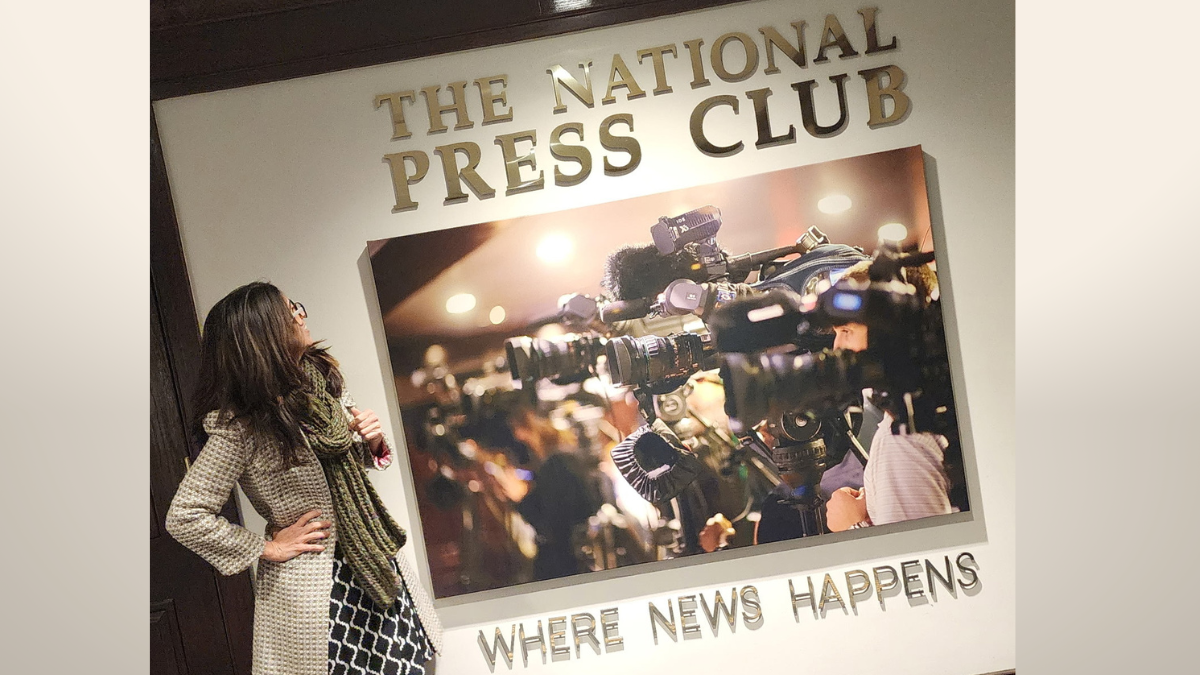
How a Latina Journalist Brought a Hidden Crisis to the National Press Club Stage
By Catherine Jones
It started with an email from Dr. Bandy Lee. She was putting together a conference at the National Press Club in Washington, D.C., called “The Hidden Epidemic of Family Court Violence” and asked me to help produce a short documentary for it. I said “yes” before I even thought about it. She didn’t have to ask me twice. This past November, the documentary premiered at the conference.
I’m not a documentary filmmaker. But I trusted Dr. Lee. And I knew I was, and am, very qualified to tell the story of family court violence and abuse. She emailed the right gal.
I’ve spent my career in media, starting with an appearance on Telemundo’s Hoy en el Mundo, with Host Jose Diaz-Balart, to co-hosting a Today show parenting web series with fellow Latina mom Rachel Campos-Duffy. But, these days, I mostly refer to myself as a print journalist and an all-around storyteller. However, for the task at hand, I brought something more important than a résumé. I understood just how dark, and overlooked, our nation’s family courts can be. I’d reported on it, and, most importantly, I’d lived it.
Admittedly, a decade ago, I didn’t know family court was a thing. I thought court was court, you know, with the judges, the juries, and the usual setup we’ve all seen on TV shows like Law & Order: Special Victims Unit. But family court, I quickly found out, exists in its own separate world.
It’s a division of the judicial system that handles issues like divorce, child custody, visitation, and support. And there are no juries with Lady Justice looking on. It’s quite the opposite actually. There’s just one judge who makes life-altering decisions, in closed-off courtrooms, based on testimony and reports from “experts” who don’t exactly tell the truth.
Like thousands of protective mothers across the country, I cannot unsee the horrors of family court abuse. And, now, during Family Court Awareness Month, Dr. Lee was letting me make a film about it.
Dr. Bandy Lee, for those not familiar with her, is a forensic psychiatrist and violence expert who taught at the Yale School of Medicine. She became internationally known after editing The Dangerous Case of Donald Trump and has spent her career studying how systems cause psychological harm. As of late, she’s been interested in family court because, well, it’s personal.
The mini-documentary centers on her sister, Patricia Lee, a mother of two. From the outside, Patricia had it all together. She was a suburban PTA mom living in an upscale neighborhood in New Jersey, with no criminal record or history of abuse. Like so many women, she was going through a divorce.
Then came the raid.
“The children were taken by police raid on November 12, 2021, at approximately 6 p.m., just when her parenting weekend was beginning. It was also her birthday and before the holidays, so it was timed to maximally deprive Patricia and her children,” Dr. Lee told me.
Patricia hasn’t seen her children since. On that day, she lost full custody, with no planned visits, or even a phone call, in sight. Most people believe there has to be more to the story. They assume the courts would never separate a mother from her children without a serious reason. I used to think that too. But, once you’ve seen how the system really works, you understand just how wrong that assumption can be. You can’t unsee the truth.
As I’ve reported for major outlets, including MIami’s ABC affiliate, WPLG news, the pattern of family court abuse is real, and it keeps on repeating. Mothers like Patricia are being erased from their children’s lives by a system that profits from conflict and chaos. At the D.C. conference, New Hampshire Representative J.D. Bernardy explained a questionable family court decision, like handing children over to an abusive parent, is a money-making operation. It keeps the cash “flowing and flowing … with some of the worst consequences,” he said.
In the documentary, I included short clips of mothers – from well-known activist Tina Swithin to a small town optometrist Dr. Kreslyn Barron Odum – telling their stories and footage of children being sent to controversial “reunification” camps. The trauma is plain to see.
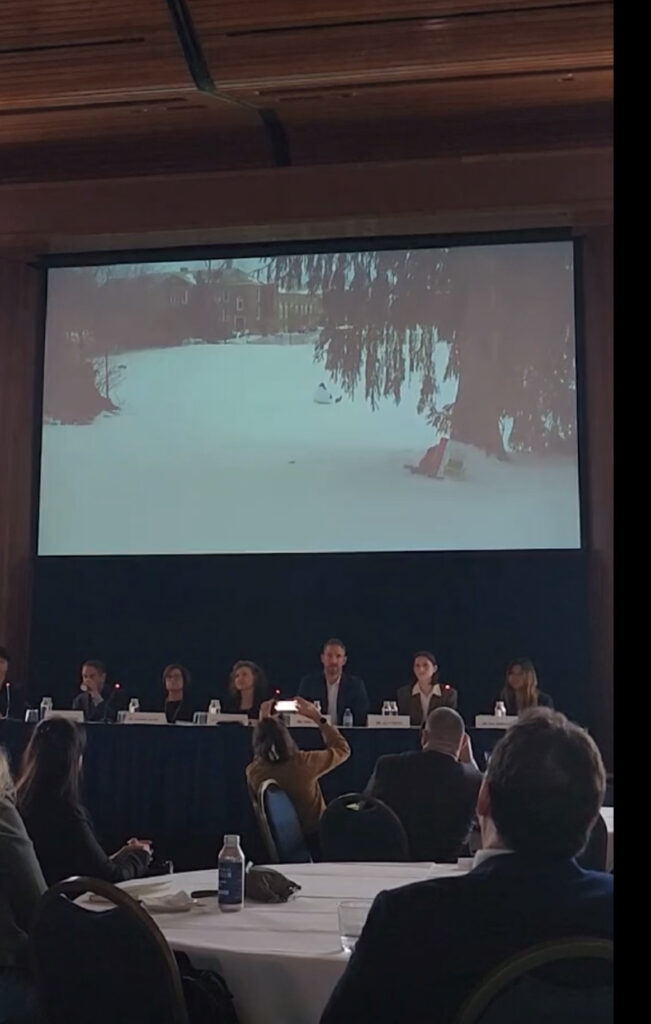
When the lights dimmed at the National Press Club and the film began to play, I was in awe. There it was on the big screen: the story that had consumed my every thought for days. Leaders, journalists, survivors, experts watched in silence. Some with their phones held up recording the whole thing.
As a Latina, I know how rare it is to have the opportunity to create something like this. Very few Latinas ever get the chance to shape these kinds of stories from behind the camera. In fact, according to the USC Annenberg Inclusion Initiative, Latinas make up less than 2 percent of behind-the-scenes roles in film and television. That number is far too small, especially when the stories are this important. And we know how to tell them.
As NPR put it, “the field is still heavily dominated by white men.”
For now, I hope more people watch the short doc, which is available on Dr. Lee’s YouTube channel, “OutSide Observer.” She says she is also showing it to members of Congress, with the hope of prompting a hearing on family court abuse and violence. This is the power of storytelling at its finest: moving people to act.
I hope the film stays with everyone, especially those in Congress. And, more than anything, I hope no one else has to endure what Patricia Lee has gone through. But, sadly, you know that more protective mothers just might.
Because, once you’ve seen it, it can’t be unseen.
About the Author