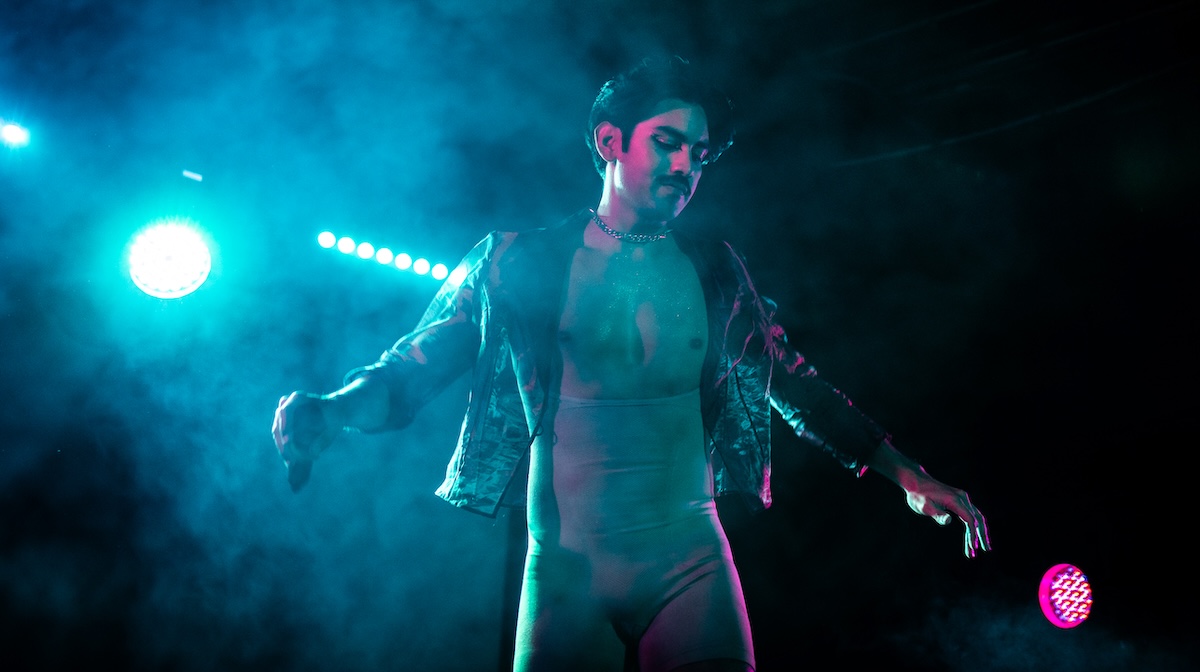
The Salvadoran artist teams with Argentinian filmmaker Francisco Passuelo for ‘Crying at the Dairy Queen,’ signaling a new era of cross-disciplinary Latino storytelling.
The traditional music video has always been a powerful promotional tool. But for a new generation of artists, it can be something much bigger: a short film, a piece of visual storytelling, and an extension of the artist’s identity.
Salvadoran singer-songwriter JANDROU is betting on that idea.
Ahead of the release of his upcoming single Crying at the Dairy Queen, JANDROU has partnered with Argentinian filmmaker Francisco Passuelo to create a cinematic short film inspired by the song. And while the details of the narrative are being kept under wraps, the creative decision itself says plenty about where JANDROU wants to take his career.
This isn’t being positioned as simply another music video. It’s filmmaking.
When Music Meets Cinema

JANDROU has conceived the project as a standalone cinematic work in which the song and narrative exist on equal footing. The objective is to create an emotional visual experience that can stand on its own while expanding the story behind the music.
That distinction matters.
The music industry has increasingly become a visual business. Artists aren’t simply releasing songs; they’re creating aesthetics, characters, narratives and entire worlds that extend across music videos, film, social media and live performance.
For independent artists, that can be particularly powerful. Without the machinery of a major studio or label behind every creative decision, the ability to build a distinctive visual identity can become part of the brand itself.
JANDROU appears to understand that. And he has chosen a filmmaker rather than simply a music-video director to help execute the vision.
Enter Francisco Passuelo
Born in Buenos Aires and based in Vancouver since 2010, Passuelo brings an international filmmaking perspective to the project.
He is the founder of Latin Canada, a production company dedicated to amplifying Latin voices in film. His documentary Luis at Home has also been making its way through the international film festival circuit.
That background gives the collaboration an interesting dimension.
Passuelo isn’t coming into the project simply to translate a song into images. His work is rooted in character, intimacy and emotional storytelling—the very qualities JANDROU wants to bring into the project.
Together, the two artists represent a broader Latin American creative ecosystem that increasingly operates beyond borders. Los Angeles. Buenos Aires. Vancouver. Different cities, different industries, one increasingly connected creative community.
The Latino Creative Economy Is Crossing Industries
For decades, Latino artists have often been placed into narrowly defined categories: singer, actor, filmmaker, journalist, producer. But today’s creative economy is increasingly dismantling those boundaries.
A musician can become a filmmaker. A filmmaker can become a producer. A producer can build a media company. And an artist can develop an entire intellectual property universe around a song, character or story.For Latino creatives, that cross-pollination is particularly significant.
The industry has spent years talking about the need for greater Latino representation on screen. But representation isn’t only about who appears in front of the camera. It is also about who controls the narrative behind it.
Who writes the story.
Who directs it.
Who produces it.
Who owns the creative vision.
JANDROU’s collaboration with Passuelo puts two Latin American creatives in those positions.
A Bigger Canvas for “Handsome in Pink”
The short film also arrives as JANDROU prepares his debut album, Handsome in Pink.
The project is being developed with British producer Dylan Cooper, whose credits include Post Malone, Charli XCX and Ashnikko, as well as Canadian producer Joshua Eastman.
The international makeup of the team mirrors the increasingly global nature of JANDROU’s artistic ambitions. But the strategy goes beyond assembling an impressive list of collaborators.
JANDROU appears to be constructing an identity. And that identity isn’t confined to a playlist.
By creating a cinematic piece around “Crying at the Dairy Queen,” he is giving audiences another way into his music—and potentially creating a visual language that can follow him beyond the debut album.
That becomes particularly important for an independent artist building toward greater industry recognition and Grammy consideration. In an overcrowded music marketplace, the question isn’t simply whether an artist can make a good song. It’s whether audiences can remember the world surrounding it.
The Story Is Still a Secret
For now, JANDROU and Passuelo aren’t revealing what actually happens in Crying at the Dairy Queen. And perhaps that’s the point.
In an era when much of the entertainment industry is built around immediate reveals, trailers, clips and social media teasers, allowing the story to remain a mystery creates its own anticipation.
What we do know is that JANDROU isn’t approaching his upcoming release as a one-off song with a video attached. He’s thinking cinematically. That may prove to be one of the more interesting aspects of his evolution.
Because the future of music may not belong solely to artists who can deliver the next hit. It may belong to those who understand how to turn a song into a story—and a story into a world audiences want to enter.
For JANDROU, Crying at the Dairy Queen could be the beginning of that world.
And if the short film delivers on its promise, audiences may discover that the most interesting thing about the song isn’t just what they’re hearing.
It’s what they’re about to see.
About the Author