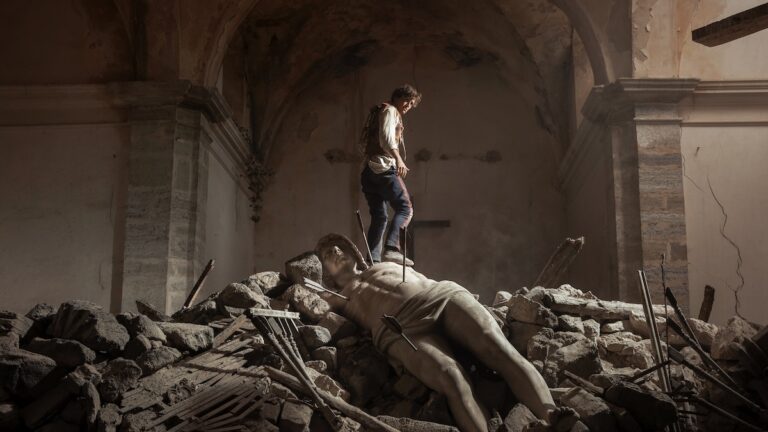

There are few operas as instantly recognizable as Georges Bizet’s Carmen. Its seductive melodies, defiant heroine and tragic ending have traveled far beyond the opera house, becoming part of the world’s collective musical imagination. But at LA Opera, the familiar story takes on a darker dimension, examining the dangerous intersection of freedom, obsession, tradition and control.
Dorothy Chandler Pavilion, new production, which opened October 17, 2026, marks LA Opera’s first new staging of Bizet’s masterpiece since 1998. It also inaugurates the music directorship of Domingo Hindoyan, whose arrival signals a new chapter for the Los Angeles company.
Directed and designed by Thaddeus Strassberger, the production trades the picturesque imagery often associated with Spain for a haunting visual world inspired by Spanish photographer Cristina García Rodero’s España Oculta (Hidden Spain). Towering Gothic architecture, religious imagery, candlelit processions and the tension between public devotion and private desire shape a production that places the opera’s central conflict within a society governed by tradition.
The result is a Carmen that asks audiences to look beyond the familiar melodies and consider the human cost of a woman’s refusal to surrender her freedom.
The Story: A Woman Who Refuses to Be Possessed
First performed in Paris in 1875, Carmen tells the story of a fiercely independent woman whose attraction to a soldier sets off a chain of increasingly destructive events.
Carmen, a cigarette-factory worker in Seville, captivates Don José, a soldier who abandons his obligations and eventually his former life to pursue her. What begins as desire becomes an all-consuming attachment. When Carmen turns her attention to Escamillo, a celebrated bullfighter, Don José’s jealousy intensifies, exposing the difference between loving someone and believing you have a right to possess them.
Beneath the drama lies a story that remains painfully contemporary: a woman insists on making her own choices, while a man unable to accept her independence turns rejection into violence.
LA Opera’s own introduction to the production emphasizes the central tension: Carmen belongs to herself, even as the people around her seek to define, desire or possess her.
Rihab Chaieb Brings Carmen to Life
At the center of the production is Tunisian-Canadian mezzo-soprano Rihab Chaieb, whose portrayal has emerged as one of its most celebrated elements.
Chaieb brings both vocal richness and physical authority to the title role, portraying Carmen as a woman whose sensuality is inseparable from her intelligence and determination. Rather than reducing her to the traditional femme fatale, the performance gives her agency and emotional complexity. Critics have praised her stage presence and musicality.
Opposite Chaieb, tenor Joshua Guerrero plays Don José, the soldier whose attraction becomes destructive obsession. Guerrero, a Grammy-winning Mexican-American tenor and former member of LA Opera’s Domingo-Colburn-Stein Young Artist Program, brings emotional vulnerability and vocal power to the role.
Together, the principal cast grounds the production’s grand visual world in the emotional triangle that drives the tragedy.
This production is not simply a revival of a familiar favorite. It is an ambitious reinterpretation, and its artistic choices have prompted debate about how much visual spectacle a classic opera needs.
Choreographer Antonio Najarro, a leading figure in Spanish dance and flamenco, contributes movement that connects the production’s physical energy to its cultural setting.
The staging draws on the visual language of Holy Week processions, religious devotion and Spain’s darker folkloric traditions. In Act III, the smugglers’ camp becomes a cemetery, a place where the living and the dead seem to occupy the same territory. In the final act, the crowds gather for the bullfight as religious processions move through the city.
According to LA Opera, strong ticket demand led the company to add a seventh performance to the original six-performance run. That range of responses is part of what makes the production worth discussing. The response to LA Opera’s Carmen has extended beyond the critical conversation.
Why ‘Carmen’ Still Matters
The enduring power of Carmen lies in its refusal to offer a comfortable resolution. Carmen is neither rewarded for her independence nor transformed into a figure who regrets it. She remains committed to her freedom until the end.
That makes the opera more than a showcase for Bizet’s celebrated score. It is a tragedy about control, gender, jealousy and the violence that can follow when a person refuses to accept another’s autonomy.
LA Opera’s new production brings those questions into sharp relief through its Spanish Gothic setting, its religious imagery and its emphasis on the collision between individual desire and social convention.
About the Author